
At the end of a long day, many of us finally sit down, pick up our phones, turn on the television, and tell ourselves that we are resting. An hour later, we may realize that we have answered several text messages, watched half an episode of something, scrolled through social media, checked our email, read a few upsetting news stories, and somehow feel just as mentally exhausted as we did before we sat down. Our bodies may have stopped moving, but our brains certainly did not. This raises an important question: Are we actually resting, or are we simply sitting down?
Rest is often treated as something we earn after everything else is finished, but for most of us, everything is never truly finished. There will always be another load of laundry, another email, another patient or client question, another household project, or something else we could accomplish. When productivity becomes our default setting, slowing down can even make us feel uncomfortable or guilty. However, periods of genuine recovery are not wasted time; they are an important part of supporting our physical, mental, and emotional health.
Your Brain May Still Be “On” Even When Your Body Stops
Modern life gives us very few opportunities to experience true quiet unless we intentionally create them. Our phones provide an almost endless supply of information, entertainment, messages, notifications, news, and social interaction. Sitting on the couch while consuming all of that information may give our muscles a break, but it does not necessarily provide the same kind of mental recovery as genuinely disengaging from stimulation. In fact, research has increasingly examined how constant digital engagement may affect stress, sleep, attention, and psychological well-being.
A systematic review and meta-analysis by Mougharbel et al. (2023) examined social media use and psychological well-being among adults and found associations between excessive or problematic social media use and poorer mental health outcomes. These findings do not mean that social media is inherently harmful or that everyone needs to delete their accounts. Social media can provide connection, education, entertainment, and community, but the way we use it matters. If our primary method of “relaxing” keeps our minds engaged, comparing, responding, processing, and consuming information, we may not be giving ourselves the restorative break we think we are.
Stress Is Normal, but Recovery Matters
Stress is not automatically bad. Our bodies are designed to respond to challenges through coordinated changes involving the nervous system and the hypothalamic-pituitary-adrenal axis, helping us respond appropriately to physical and psychological demands. Problems can arise when stress becomes persistent and opportunities for recovery become limited. Over time, chronic stress has been associated with changes across cardiovascular, metabolic, immune, and mental health domains (Mariotti, 2015).
This does not mean that every busy day is damaging your health or that you need to eliminate stress from your life. Eliminating stress would be both unrealistic and, frankly, impossible. Instead, we can become more intentional about creating moments when our bodies and minds are not constantly responding to another demand. The goal is not a stress-free life; it is developing a life that includes opportunities to recover from stress.
What Does Real Rest Look Like?
Rest does not have to mean lying completely still in a silent room. For one person, recovery may involve reading a book, while another person may feel restored after gardening, walking through the woods, stretching, praying, listening to music,What Does Real Rest Look Like?
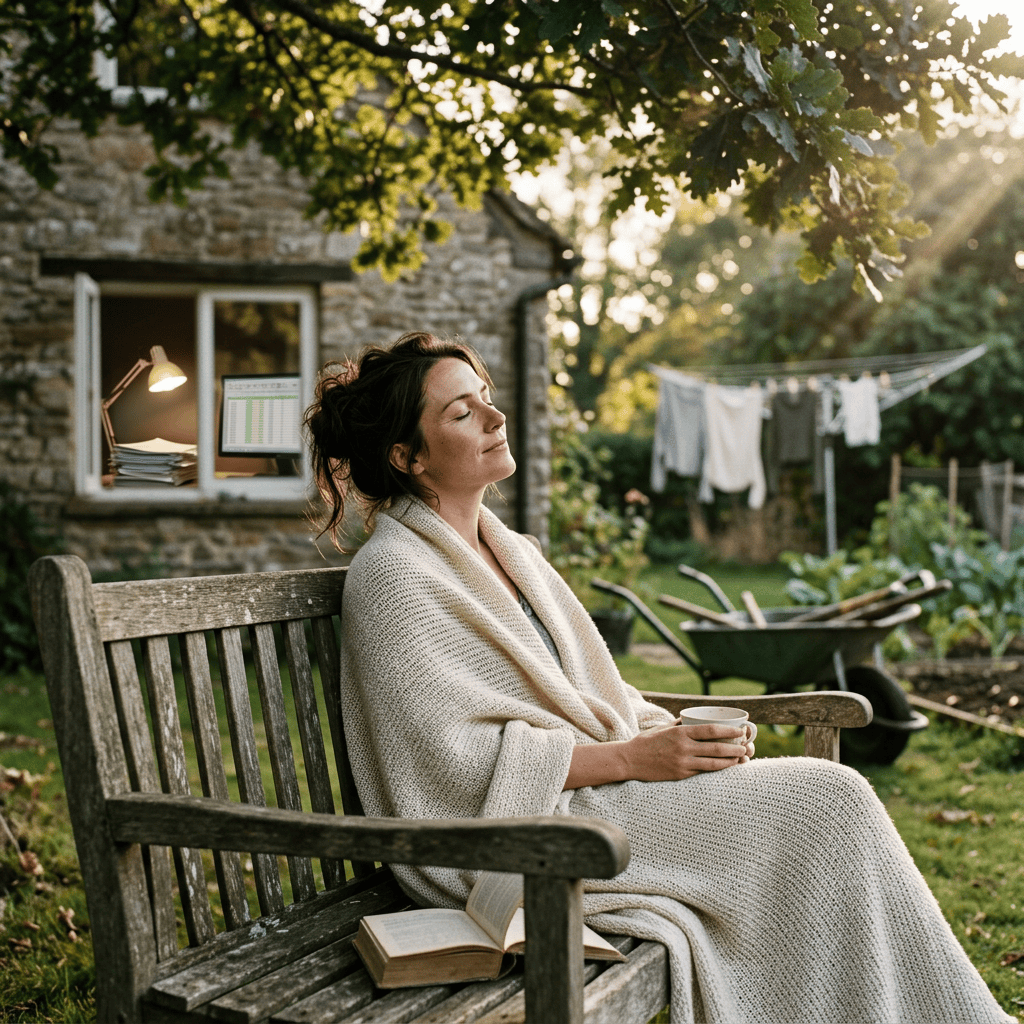
Rest does not have to mean lying completely still in a silent room. For one person, recovery may involve reading a book, while another person may feel restored after gardening, walking through the woods, stretching, praying, listening to music, or sitting outside with a cup of tea. Some people need solitude after spending their day interacting with others, while someone who works from home alone may actually find dinner with friends restorative. Rest is less about one specific activity and more about whether that activity leaves you feeling replenished rather than depleted.
Nature may be particularly valuable in this area. A systematic review and meta-analysis by Nguyen et al. (2023) found that nature-based interventions were associated with improvements in several adult mental health outcomes, including reductions in depressive mood and anxiety. Other research has linked exposure to natural environments with psychological restoration and reductions in stress. You do not need to disappear into the mountains for a week to benefit from being outdoors; spending time in a park, gardening, walking a wooded trail, or simply sitting outside can create intentional separation from some of the stimulation of everyday life.
Sometimes Rest Looks Like Movement
Interestingly, one of the best ways to recover from a mentally stressful day may involve moving your body rather than lying on the couch. Physical activity has consistently been associated with better mental health, including reductions in symptoms of depression and anxiety. A large systematic review and network meta-analysis published in The BMJ found that several forms of exercise, including walking or jogging, strength training, yoga, and mixed aerobic exercise, were effective at reducing depressive symptoms (Noetel et al., 2024). The authors concluded that exercise should be considered alongside other established treatments for depression, although treatment decisions should always be individualized.
This is an important reminder that physical rest and mental rest are not always the same thing. If you have spent eight hours doing physical labor, sitting down may be exactly what your body needs, but if you have spent eight hours sitting at a computer or listening to other people’s problems, movement may feel much more restorative. A quiet walk outside can provide physical activity while simultaneously creating distance from screens, responsibilities, and constant input. Sometimes the thing that feels like effort initially is actually what helps us decompress the most.

Sleep Is Not the Same as Rest Either
Sleep is absolutely essential, but we should not expect sleep to compensate for a day that contains no opportunities for mental recovery. Adults generally need at least seven hours of sleep per night on a regular basis to promote optimal health, although individual needs vary (Watson et al., 2015). Adequate sleep supports cognition, immune function, metabolism, cardiovascular health, emotional regulation, and numerous other physiological processes. Protecting sleep should therefore remain one of the foundations of a healthy lifestyle.
However, we also need moments during our waking hours when we are not constantly performing, producing, solving, responding, or consuming information. Waiting until bedtime to finally stop can make it difficult to transition directly from a highly stimulated state into sleep. Creating an evening wind-down period can help establish separation between the demands of the day and the time intended for sleep. Dimming lights, reducing screen exposure, reading, stretching, praying, journaling, or preparing for the following day can become signals that it is time to slow down.
There Is a Spiritual Side to Rest
For me, conversations about rest are incomplete without acknowledging spiritual health. Scripture does not present rest as laziness or weakness; instead, rhythms of work and rest appear throughout the Bible. In Mark 6:31, Jesus tells His disciples, “Come with me by yourselves to a quiet place and get some rest” (New International Version). These were people doing meaningful and important work, yet rest was still necessary.
The biblical concept of Sabbath also challenges our tendency to connect our value with constant productivity. Setting aside time for worship, family, prayer, reflection, and restoration reminds us that life is more than the number of things we accomplish. Even outside of a formal Sabbath practice, intentionally creating quiet space can provide an opportunity to pray, reflect, practice gratitude, and reconnect with what matters most. Spiritual rest does not eliminate our responsibilities, but it can change the way we carry them.
Try Creating a “Rest Menu”
If you struggle to slow down, it can be helpful to identify several activities that genuinely make you feel restored. Think of this as a personal “rest menu” that you can choose from depending on how much time you have and what kind of recovery you need. Your five-minute options might include stepping outside, stretching, praying, breathing deeply, or drinking a cup of tea without looking at your phone. When you have 30 minutes or longer, you might choose a walk, yoga, reading, gardening, photography, a bath, a hobby, or meaningful time with someone you love.
It can also be helpful to pay attention to how you feel after an activity rather than simply labeling it as relaxing. If 45 minutes of scrolling consistently leaves you more anxious, distracted, or dissatisfied, that information is worth noticing. You do not necessarily need to eliminate the activity, but you might decide that it is entertainment rather than restoration. Once you understand the difference, you can intentionally make room for both without confusing one for the other.
Give Yourself Permission to Stop
There will always be something else you could be doing. The kitchen could be cleaner, your inbox could be emptier, another workout could be completed, and tomorrow’s schedule could be better organized. Productivity can be valuable, but constantly chasing the feeling of being “caught up” can leave us waiting indefinitely for permission to rest. Sometimes we have to decide that enough has been accomplished for today, even when the list is not finished.
Tonight, when you finally sit down, pay attention to what happens next. Notice whether you are actually allowing your mind and body to recover or simply replacing one form of stimulation with another. Try putting the phone down, stepping outside, stretching, praying, reading a few pages of a book, or simply sitting quietly for several minutes. Rest is not the absence of productivity; it is part of what allows us to return to our lives with the energy to be present for the people and responsibilities that matter most.

Written By: Roxanne Oliver, DNP, APRN, FNP-BC, CHHP
*The information contained in this post is for information only. It does not replace routine follow-up and/or care with a certified and licensed medical provider
References
Mariotti, A. (2015). The effects of chronic stress on health: New insights into the molecular mechanisms of brain-body communication. Future Science OA, 1(3), FSO23. https://doi.org/10.4155/fso.15.21
Mougharbel, F., Chaput, J.-P., Sampasa-Kanyinga, H., Hamilton, H. A., Colman, I., Leatherdale, S. T., & Goldfield, G. S. (2023). Heavy social media use and psychological distress among adults: A systematic review and meta-analysis. Journal of Affective Disorders.
Nguyen, P.-Y., Astell-Burt, T., Rahimi-Ardabili, H., & Feng, X. (2023). Effect of nature prescriptions on cardiometabolic and mental health, and physical activity: A systematic review. The Lancet Planetary Health, 7(4), e313–e328. https://doi.org/10.1016/S2542-5196(23)00025-6
Noetel, M., Sanders, T., Gallardo-Gómez, D., Taylor, P., Del Pozo Cruz, B., van den Hoek, D., Smith, J. J., Mahoney, J., Spathis, J., Moresi, M., Pagano, R., Pagano, L., Vasconcellos, R., Arnott, H., Varley, B., Parker, P., Biddle, S., & Lonsdale, C. (2024). Effect of exercise for depression: Systematic review and network meta-analysis of randomised controlled trials. BMJ, 384, e075847. https://doi.org/10.1136/bmj-2023-075847
Watson, N. F., Badr, M. S., Belenky, G., Bliwise, D. L., Buxton, O. M., Buysse, D., Dinges, D. F., Gangwisch, J., Grandner, M. A., Kushida, C., Malhotra, R. K., Martin, J. L., Patel, S. R., Quan, S. F., & Tasali, E. (2015). Recommended amount of sleep for a healthy adult: A joint consensus recommendation of the American Academy of Sleep Medicine and Sleep Research Society. Sleep, 38(6), 843–844. https://doi.org/10.5665/sleep.4716or sitting outside with a cup of tea. Some people need solitude after spending their day interacting with others, while someone who works from home alone may actually find dinner with friends restorative. Rest is less about one sp
Want to Learn More?
Want more practical, evidence-based information about nutrition, functional medicine, hormones, healthy living, and wellness? Follow along on Instagram and TikTok @roxanneoliver_dnp, where I share education, healthy lifestyle tips, recipes, and realistic ways to support your health. I believe wellness should be understandable, sustainable, and something you can actually incorporate into real life.

